


Making of: Hapert’s impressive ‘Don’t Try This at Work’ campaign – 5 challenges that prove the power of quality trailers
The ‘Don’t Try This at Work’ campaign by Hapert is anything but a standard product campaign. With five spectacular challenges, Hapert shows what real quality trailers can withstand. No theoretical tests, but visually impressive real-life situations in which strength, stability and craftsmanship take centre stage.
In this blog post, we take you behind the scenes. How was this campaign created? What happened between takes? And most importantly: how do these extreme tests make Hapert’s reputation as a producer of quality trailers even stronger?
Welcome to the making of.
Challenge 1 - Fast Track Trial

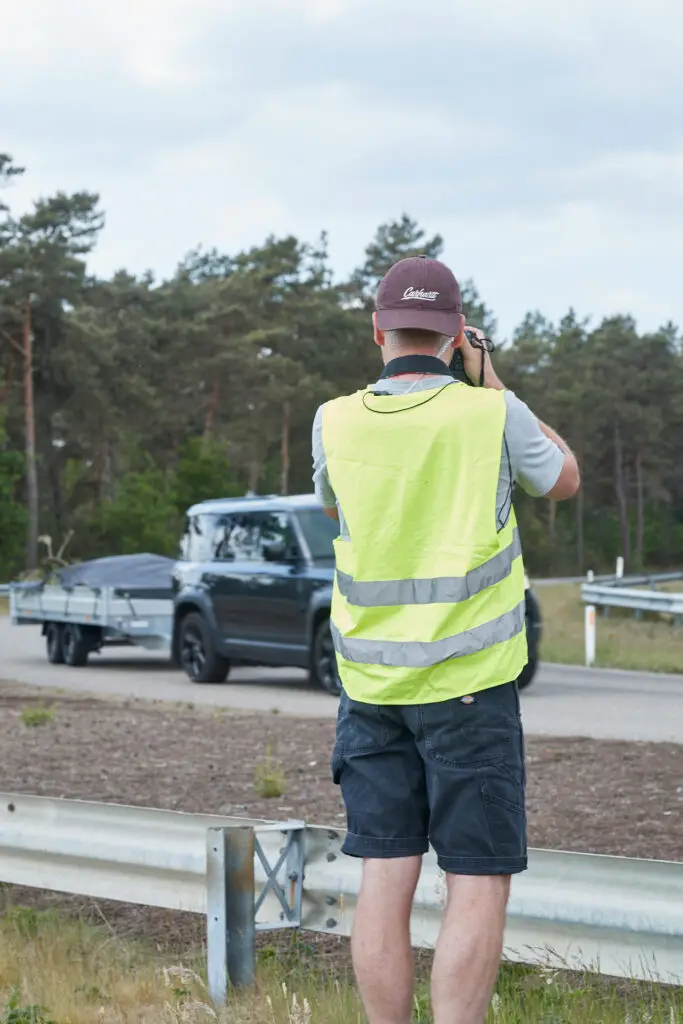
The first challenge was all about speed, stability and control. But before even a single metre was driven, the set already felt like a high-performance operation.
The entire test location was full of cables, camera rails and precisely measured markings. With measuring tapes and laser levels, the team checked whether every metre of the track was positioned exactly right. Because in speed tests, every millimetre counts.
Behind the scenes
Cameras were mounted on rails for smooth tracking shots
Generators ran continuously to provide stable lighting
The sound of “Ready? Stand by!” echoed across the site
Dust was constantly blown away to keep the image sharp
Between runs, the trailer was checked again and again: tyre inspection, coupling check, lashing points reviewed. That is not for show. That is quality in action.
What this challenge proves: a quality trailer must remain stable at high speed and under repeated load. The Fast Track Trial showed that the construction, chassis and axle technology have no weak links.
Challenge 2 - Tug of Torque

Where Challenge 1 focused on speed, Challenge 2 was all about pure pulling power.
The test area was prepared extensively in advance. Cable tension was calculated precisely, anchor points were tested and the exact action moment was timed down to the second. Mechanics, technicians and camera crew worked closely together to make sure everything happened in sync.
What really happened on set
Vehicles were repositioned several times
Couplings were checked again and again
Ground markings determined exact positions
Equipment was continuously calibrated
At the side of the set, a crew was ready with gloves, steel pins, duct tape and extra fastening material, because when measuring force, you do not take risks.
The core of this challenge: quality trailers stand out in pulling power and structural strength. A frame that does not deform. Lashing points that do not give way. That is exactly what was visually proven here.
Challenge 3 - Sand Slam

Sand is unforgiving, and that is clearly visible during Challenge 3. It gets into bearings, between hinges and into every gap. Perfect for testing the durability of a trailer.
The location was set up early. Large piles of sand were moved with loaders to create the right configuration. Camera teams balanced on ladders and sand hills to find the perfect angle.
Production in extreme conditions
Each take only started once the dust had settled. Microphones were protected against wind and flying sand. Cameras were cleaned after every shot.
The crew was literally knee-deep in sand. Meanwhile, the trailer was checked again and again, because sand does not only test strength, but also sealing and wear resistance.
Challenge 4 - Hang On

This challenge was all about control and technical precision.
Dozens of markers were placed on set for safety, camera angles and construction points. Everything was measured three times before action took place.
It almost felt like a construction site:
- Walkie-talkies in constant communication
- Safety harnesses and gloves
- Technicians with spirit levels and measuring equipment
- Camera crew manoeuvring between arms and rigs
Between takes, cables were tensioned again and frames were adjusted. No detail was left to chance.
What Hang On underlines: stability, construction quality and controlled load are crucial for professional quality trailers. This challenge brought that technical craftsmanship to life visually.
Challenge 5 - Container Crush

The most visual and intensive challenge of the campaign.
The set was full of heavy equipment: forklifts, jacks, freight containers and heavy camera rigs. Everything started with precise measurement and technical inspection of mechanical components.
The sound? A mix of steel, machines and walkie-talkie communication.
Before every take, everything was paused:
- Cameras ready
- Sound ready
- Technical team ready
After every recording, the container was inspected, equipment was readjusted and new close-ups were planned.
Why this works so powerfully: Container Crush shows that quality trailers are not only built to take a hit. They are designed for maximum load and structural reliability.
The impact of the ‘Don’t Try This at Work’ campaign
This campaign is more than entertainment. It is visual proof of product quality.
Where traditional product pages show specifications, this campaign shows performance. And that is exactly what works in modern marketing:
- Authenticity
- Transparency
- Visual proof
- Technical trust
For anyone searching online for quality trailers, this campaign offers something unique: tangible proof.
Frequently asked questions about the campaign
1. What is the purpose of the ‘Don’t Try This at Work’ campaign?
The goal is to demonstrate the strength and reliability of quality trailers in a spectacular way.
2. Were the challenges really carried out?
Yes, all challenges were actually carried out under controlled conditions.
3. Why is this campaign important for professionals?
Because professionals want to see how a trailer performs under extreme load, not just on paper.
4. What makes quality trailers different from standard trailers?
They stand out through material choice, construction, welding technology, finishing and testing procedures.
5. How does this campaign contribute to brand trust?
By transparently showing what the product can do, credibility and trust are created.
6. Where can I find more information about Hapert trailers?
Visit product specifications and dealer information.
More than a campaign
The ‘Don’t Try This at Work’ campaign proves that quality trailers are not just built to transport. They are built to perform.
Behind every spectacular shot was a team of technicians, camera crew and specialists who share the same core value: quality without compromise.
And that is visible in every challenge.