


Trailer tyre pressure: how many bar and how do you keep your tyres in top condition?
A trailer that carries heavy loads, travels long distances or is used every day needs tyres you can rely on. The correct trailer tyre pressure is just as important as the condition of the tyres themselves.
But how many bar should be in your trailer tyres? How do you check trailer tyre pressure? And when do your tyres need replacing?
At Hapert Trailers, we help you get started. With our tyre pressure table, practical maintenance tips and clear explanation of tyre wear, you can keep your trailer in good condition.
Quick answer
How many bar should be in a trailer tyre?
The correct trailer tyre pressure depends on the tyre size, tyre type, load capacity and the manufacturer’s specifications. For different Hapert trailers, the prescribed pressure ranges from approximately 2.9 to 6.5 bar. There is no general trailer tyre pressure that applies to every trailer.
Always check the full tyre size and use the corresponding approved trailer tyre pressure.
What is the correct tyre pressure for my trailer?
The tyres of your trailer are the only contact with the road surface. The correct trailer tyre pressure therefore contributes to stable road handling, predictable driving behaviour and a longer tyre life.
How many bar you need depends on the fitted tyres and the specifications for your trailer.
Some trailer tyres require a relatively high tyre pressure. This applies, for example, to certain C tyres, which are designed to carry heavier loads.
Therefore, do not automatically use the same tyre pressure as for your car. First check the tyre size shown on the sidewall of the tyre.
Please note: the maximum tyre pressure is not always the recommended tyre pressure.
On the sidewall of a tyre, you will find information including the load capacity and the maximum permitted pressure. This does not mean that every tyre should automatically be inflated to that maximum value.
Use the prescribed trailer tyre pressure for the relevant tyre version, load and trailer. If in doubt, ask your dealer to check which pressure applies. The ANWB also emphasises the importance of tyre pressure being matched to the load.
Hapert tyre pressure table: how many bar per tyre size?
In the table below, you will find the trailer tyre pressure for various tyres used by Hapert. These values can also be found in the user manual of your Hapert trailer.
Find your tyre size
| Tyre size | Bar | PSI | Max. load |
| 155/80R13 | 2.9 | 42 | 500 |
| 165R13C | 4.5 | 65 | 710 |
| 185/70R13 | 3.0 | 44 | 650 |
| 175R14C | 4.5 | 65 | 775 |
| 185R14C | 4.5 | 65 | 900 |
| 155/70R12C | 6.5 | 95 | 900 |
| 195/50R13C | 6.5 | 95 | 900 |
| 195/55R10C | 6.2 | 90 | 750 |
| 205/70R15C | 3.8 | 55 | 900 |
| 145/70R13 | 3.0 | 44 | 425 |
| 18.5×8.5-8 | 3.4 | 50 | 425 |
| 185/70R13C | 6.0 | 85 | 950 |
Check the complete tyre specification and the instructions that apply to your current tyres. Hapert advises against using different tyres. However, your dealer or a previous owner may have fitted different tyres than the tyres originally supplied by Hapert.
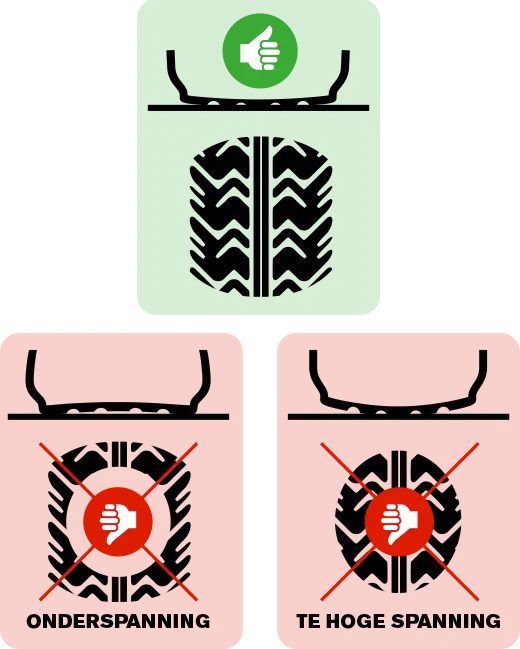
Why is the correct trailer tyre pressure so important?
With the correct trailer tyre pressure, you get more out of your trailer. Tyres with the right pressure contribute to good road handling and predictable driving behaviour. They also help prevent unnecessary wear.
The correct pressure also makes a difference to fuel consumption and tyre life. According to the ANWB, tyre pressure that is too low increases rolling resistance, wear and the risk of overheating.
Correct trailer tyre pressure has several advantages: it limits unnecessary rolling resistance and tyre wear, supports grip and braking behaviour, maintains trailer stability and reduces the risk of tyre damage caused by excessive deformation.
Your trailer can also absorb uneven road surfaces better when the tyre pressure suits the construction and load. This is especially important if you drive across an unpaved construction site, for example.
However, the correct trailer tyre pressure alone is not enough. Also ensure that the load is properly distributed and secured, and take the prescribed nose weight into account.
How often should you check trailer tyre pressure?
Hapert advises checking your trailer tyres every two weeks. Do not only check trailer tyre pressure, but also look for damage, wear and the general condition of the tyres.
Do you use your trailer every day, transport heavy loads or plan a long journey? Then an extra check before departure is recommended.
Preferably measure trailer tyre pressure when the tyres are cold. This means that the trailer has been stationary for some time or has only travelled a short distance.
A tyre that warms up while driving has a higher air pressure, because air expands when it becomes warm. As a result, you may get an incorrect reading if you measure the pressure immediately after a long journey.

Checking and topping up trailer tyre pressure in five steps
You do not need to be an experienced mechanic to check the tyre pressure of your trailer. With a good tyre pressure gauge or tyre inflator, you can easily do this yourself.
Check when the tyres are cold
Measure the trailer tyre pressure before you leave. If you have already driven, make sure it was only a short journey and that the tyres have not noticeably warmed up.
Find the correct trailer tyre pressure
Check the tyre size on the sidewall of your tyre. Look up the prescribed pressure in the Hapert specifications and set the tyre inflator to the correct value.
Unscrew the valve cap
Turn the cap anticlockwise from the valve and place it somewhere clean where you cannot lose it.
Measure and correct the pressure
Place the nozzle straight onto the valve and press it firmly. Add air or release air until the prescribed pressure has been reached. With an automatic inflator, you will usually hear a signal when it is ready. Then replace the valve cap.
Also check the spare wheel
Do you have a spare wheel? Also check its tyre pressure, tyre size, condition and age. This prevents unpleasant surprises in the event of a breakdown.
Practical tip
Use a tyre inflator that is suitable for the required pressure. Some trailer tyres require more than 6 bar. Not every tyre inflator at a petrol station can deliver that pressure.
What do the numbers and letters on a trailer tyre mean?
There is a lot of technical information on the sidewall of a trailer tyre. This information tells you, among other things, which tyre size you have, how much weight the tyre can carry and what the speed rating is.
This is important information when you want to check trailer tyre pressure or need new tyres.
Overview of all tyre markings
In addition to the tyre size, you will find more information on the sidewall of a tyre. The markings below come from the existing Hapert tyre tips and have been supplemented with clearer explanations.| Marking | What does it mean? |
|---|---|
| 1. Tyre brand | The manufacturer of the tyre. |
| 2. Tyre type and tread | Information about the version and type of tyre. |
| 3. Tyre width | The width of the tyre, expressed in millimetres. |
| 4. Aspect ratio | The height of the tyre sidewall as a percentage of the tyre width. |
| 5. R or D | The construction: radial or diagonal. |
| 6. Rim diameter | The diameter of the rim in inches. |
| 7. Load index | The load capacity of the tyre, indicated by an index number. |
| 8. Speed category | A letter indicating the maximum speed for which the tyre is technically classified. |
| 9. Tubeless | The tyre is designed for use without an inner tube. |
| 10. Production date | The production week and year, usually recognisable by the last four digits of the date code. |
| 11. TWI | The location of the tread wear indicators in the tyre tread. |
| 12. Reinforced | A reinforced version with a higher specified load capacity than the corresponding standard version. |
| 13. Winter markings | Including M+S and, where present, the snowflake symbol inside a mountain. Not every marking has the same meaning. |
| 14. For Trailer Use Only | Indicates on certain tyres that they are specifically intended for trailer use. |
| 15. DOT number | An identification code that also includes the production date of the tyre. |
When replacing tyres, always check whether the new tyres are suitable for your trailer. Pay particular attention to the full tyre size, load capacity, speed rating and prescribed trailer tyre pressure. The RDW sets requirements for, among other things, the load capacity of tyres and the matching tyre size on the same axle.
Not every tyre has all the markings listed above. For example, the marking For Trailer Use Only does not appear on all tyres. You should also never conclude from a speed rating that you are actually allowed to drive that fast with your trailer on public roads.

What is the DOT number and how old are my tyres?
Tyres age, even if you do not use your trailer often. That is why it is important to check not only the tread depth, but also the age of your tyres.
The production date is usually found at the end of the DOT code on the sidewall of the tyre.
How to read the DOT code
2524
| 25 | 24 |
|---|---|
| Production week 25 | Production year 24 |
This tyre was produced in week 25 of 2024.
A historic three-digit production date may appear on very old tyres. Always have such tyres assessed by a specialist.
Please note: the production date is not the same as the date on which the tyre was first fitted.
How do you check the tread depth of your trailer tyres?
Sufficient tread is necessary to drive safely. Due to wear, the tyre tread gradually becomes less deep.
According to Dutch RDW regulations, the tread depth of the main grooves on trailer tyres must be at least 1.6 millimetres across the full circumference of the tread.
However, waiting until the legal minimum has been reached is not always wise. Especially with intensive use or many journeys in wet conditions, it is important to check in time whether your tyres still provide sufficient grip.
You can check the tread depth yourself in two ways.
1. The TWI tread wear indicator
There are small rubber raised sections in the main grooves of your tyre. Their location is often indicated on the sidewall of the tyre with the letters TWI, a small triangle or another marking.
When the tread has worn down to the level of this indicator, the wear limit has been reached and the tyre must be replaced.
2. With a tread depth gauge
With a tread depth gauge or suitable calliper, you can check the tread depth more accurately.
Measure the tread at several points around the tyre. Check both the centre and both sides of the tread. This also helps you identify any irregular wear.
For assessing the legal minimum depth, the prescribed main grooves are decisive.

When should you replace the tyres of your trailer?
A trailer tyre does not have to be completely worn out to need replacing. Age, operating conditions and visible damage are just as important.
Therefore, check your tyres regularly for the following signs.
Cracks caused by dryness
Small cracks in the sidewall can indicate ageing of the rubber. Sometimes these cracks only become clearly visible after a trailer has been driven again following a long storage period.
Bulges and damage
A bulge on the sidewall can indicate internal damage, for example after hitting a kerb or a pothole. Do not continue driving with a tyre that has a bulge. Have it replaced by a dealer.
Irregular wear
Is a tyre mainly wearing on one side or in the centre? This may indicate incorrect trailer tyre pressure, overloading or a problem with the suspension or wheel alignment. Have the cause investigated by a dealer.
A visible bulge or damage where the carcass is exposed does not meet the RDW requirements for trailer tyres. In that case, it is time to replace the tyre.
When are my tyres too old?
Age alone does not always determine whether a tyre must be replaced. However, the importance of periodic checks increases as a tyre gets older.
The VACO trade association advises an annual check for tyres on recreational trailers from six years after fitting. For caravans, the ANWB also advises preventive replacement after, for example, ten years, even if the tread still appears sufficient.
For your Hapert, the tyres must always be in good technical condition. Have older tyres assessed by a dealer.
For intensive professional use, it is wise to pay extra attention to the tyres and their maintenance history.
10 tips to keep your trailer tyres in top condition
Whether you use your Hapert every day or only occasionally: with a few simple checks, you can prevent unnecessary wear and reduce the risk of tyre problems.
The Hapert tyre check
01
Check trailer tyre pressure
Measure trailer tyre pressure every two weeks and before long journeys.
02
Check the tread depth
Measure in several places and check whether the tyres are wearing evenly.
03
Pay attention to the age
Check the DOT code and have older tyres assessed periodically.
04
Prevent overloading
Take into account the permitted weight of your trailer and the load capacity of the tyres.
05
Distribute the load
Prevent one wheel or one side of the trailer from being loaded unnecessarily heavily.
06
Check the spare wheel
A spare wheel is only useful if the tyre is suitable and has the correct pressure.
07
Check the valves
Look for damage, leakage and missing valve caps.
08
Avoid long periods of standstill
Rotate the tyres several times regularly if the trailer remains unused for a longer period.
09
Protect against weather influences
Limit long-term exposure to direct sunlight and use suitable protection during storage.
10
Have your tyres checked
If in doubt, or in the event of irregular wear or visible damage, have your tyres inspected.
During long-term storage, supporting the trailer can help relieve the tyres. Store the trailer vertically or make sure the tyres are not carrying the load. In any case, ensure this is done safely with suitable support.
Not used your trailer for a long time? Check the tyres before departure
Has your trailer been stationary for a long time during the winter months or after a project? Then the tyres deserve extra attention.
During prolonged standstill, the same part of the tyre remains under load. This can cause temporary deformation. Weather conditions and ageing can also affect the condition of the rubber.
Therefore, before you drive again, check the trailer tyre pressure, tread depth, age and visible damage.
Also pay attention to the tyres after the first short journey. Check whether any new damage or abnormalities have become visible.
Especially if your trailer has been outside for a long time, a proper inspection is recommended.
Are you unsure about the condition of your tyres?
Have them checked by a Hapert dealer. Our dealers can advise you on the correct tyres, maintenance and possible replacement.
Checklist: are your trailer tyres ready for departure?
A short tyre check takes little time. Especially when you are travelling with a heavy load, it is important to check beforehand whether your tyres are in good condition.
Pre-departure check
- The trailer tyre pressure has been checked when the tyres are cold.
- The tyre pressure matches the specifications.
- The tyre tread is sufficiently deep.
- The tyres show no cracks, bulges or other visible damage.
- The tyres show no noticeable uneven wear.
- The tyres are suitable for the expected load.
- The spare wheel has been checked, if present.

Choose good maintenance. Choose certainty.
At Hapert Trailers, we build trailers designed for years of use. Regular maintenance helps keep your trailer safe and reliable.
In addition to the tyres, the brakes, suspension, coupling and lighting also deserve regular attention.
Is your trailer due for maintenance? Through our extensive dealer network, you can rely on expert advice, maintenance and repairs.
Well maintained. Ready for the next job.
A strong trailer starts with good construction. But with the right maintenance, you get the most out of it for years to come.
Frequently asked questions about trailer tyre pressure
How many bar should be in trailer tyres?
The correct trailer tyre pressure depends on the tyre size, version, load capacity and the manufacturer’s specifications. Different Hapert trailers use tyres with a prescribed pressure of 2.9 to 6.5 bar. Always consult the specific trailer tyre pressure table for your tyres.
How many bar should be in a 750 kg trailer?
Even with a 750 kg trailer, there is no fixed tyre pressure. Two trailers with the same permitted weight may have different tyres. Therefore, always check the tyre size and the corresponding specifications.
How many bar should be in a twin-axle trailer?
The correct tyre pressure for a twin-axle trailer is not determined solely by the number of axles. The fitted tyres, load capacity and specifications determine the required pressure. Check the tyres on both axles.
How many bar should be in a C tyre?
C tyres are designed for higher loads, but they do not all have the same prescribed tyre pressure. At Hapert, for example, versions with a pressure of 4.5 or 6.5 bar are available. Consult the specifications of your tyre and trailer.
How often should I check trailer tyre pressure?
Hapert advises checking trailer tyre pressure and the condition of your tyres every two weeks. Also check before long journeys and after long periods of standstill.
Should I increase trailer tyre pressure when my trailer is heavily loaded?
The required pressure may depend on the load. Only use the values prescribed for your tyres and trailer. Do not simply inflate your tyres to the maximum pressure shown on the tyre.
What is the minimum tread depth for trailer tyres?
The legal minimum tread depth in the Netherlands is 1.6 mm in the prescribed main grooves across the full circumference of the tread. Check the depth regularly with a tread depth gauge.
When should I replace the tyres on my trailer?
Replace tyres when the legal wear limit has been reached or when they are damaged and can no longer be used safely. Have older tyres inspected regularly, even if they still have sufficient tread. Follow the manufacturer’s recommendations.
How do I recognise tyre pressure that is too low?
Tyre pressure that is too low can cause excessive deformation, extra heat build-up and increased wear. You cannot always recognise low tyre pressure with the naked eye. Therefore, measure it with a tyre pressure gauge.
Where can I find the correct tyre pressure for my Hapert trailer?
You can find the prescribed values in the technical information from Hapert Trailers. Check the tyre size and corresponding specifications. If in doubt, contact an official Hapert dealer.
