Travel with peace of mind with a properly secured load
No matter how strong and reliable your trailer is, if you do not load it correctly, unsafe situations can still occur. With the tips below, you can load, unload and transport a properly secured load in a safe way. Good trailer load securing starts with the right preparation, the correct weight distribution and suitable securing equipment.
Make a loading plan: the heaviest items first
For anyone who only transports sand or leaves, or for example a car, machine or other vehicle on our Indigo, a loading plan may seem unnecessary. Still, it is useful to check the payload of your trailer in advance.
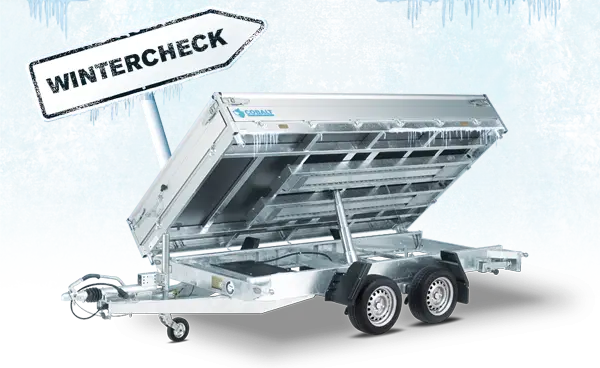
In addition, we always recommend securing and covering the load properly. Depending on what you are transporting, you can do this in an open trailer such as our Azure or Cobalt using:
A load net
A flat cover
A high cover
Or lashing straps
Securing the load in an enclosed trailer, such as our Sapphire, works best with lashing straps or the optional lashing system. This system consists of two rails and a telescopic bar. The rails are mounted on the side walls, and the telescopic bar can be clicked into place between them. This is a practical solution for anyone who wants to transport goods on pallets or roll containers. Are you transporting different items? Then start with the heaviest items. When doing so, take the trailer nose weight into account. You can read more about nose weight here. Load the lightest items onto your trailer last. These can be well protected against being blown away by using a load net. You can see why here.
Unloading the load: equilibrium, stability and balance
All our trailers can be equipped with support legs. These provide stability while loading and unloading, helping to prevent the trailer from tipping over. That is the safe way to work. Are you unloading your load with a tipping trailer? Make sure there is no counterweight in the load bed. For example, a piece of equipment fixed to the front rack. During tipping, such a counterweight can create dangerous situations. When the load bed reaches its highest point and forms a flat angle, the trailer can tip over, with serious consequences. Safe unloading is therefore also an important part of trailer load securing.
Weather check: rain, wind and storm
Before you set off, check the weather forecast. A heavy rain shower above an uncovered load of sand can double the weight of the load as the sand becomes wet. As a result, the trailer may temporarily become overloaded. In that case, it is better not to use the tipping function, because there is a risk that the trailer could tip over or the hydraulics could break. You can prevent this situation by placing a flat cover over the load.
Wind and storms can also be dangerous. For example, when you take an empty trailer onto the road. From certain speeds, the wind can get underneath the trailer and take hold of it, causing it to become unstable. This is dangerous for you as the driver, but also for other road users.A weather check is therefore a simple but important step in safe load securing and trailer transport.
Is your load properly secured? Read here what else you can do to stay safe on the road: