


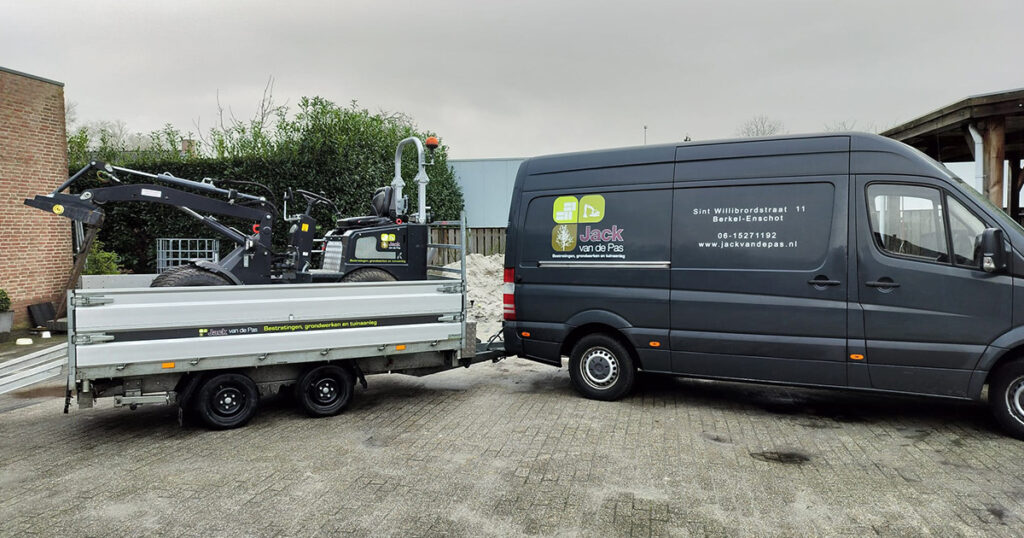
Trailer nose weight: what it is, why it matters and how to set it correctly
When driving with a trailer, plays nose weight plays a crucial role in safety, stability and driving comfort. Yet many drivers do not know exactly what nose weight means or how important the correct setting is. The wrong nose weight can lead to swaying, poor handling or even dangerous situations on the road.
At Hapert Trailers, we see in practice how important correct trailer nose weight is, especially with heavier trailers such as platform trailers, tippers and machine transporters. In this article, we clearly explain what nose weight is, how to measure it and how to load your trailer safely and stably.
What is trailer nose weight?
Nose weight is thevertical weight that the drawbar of a trailer applies to the towbar of the car. This weight is expressed in kilograms and partly determines how stable the car and trailer combination is on the road.
The maximum allowable nose weight is determined by:
the car manufacturer
the hitch manufacturer
This value is usually listed as:
vertical load
vertical load
S-value (In the European type-approval rules for mechanical coupling devices, S stands for the maximum permitted static vertical load at the coupling point.)
The permissible nose weight on most cars is between about 45 and 100 kilograms.
It is important that you never cross this line. At the same time, the nose weight should not be too low either.

Where can you find the maximum trailer nose weight of your car?
You can find the maximum nose weight in several places:
on the type plate of the tow bar
in the vehicle documentation
in the instruction booklet of the car
The value is often referred to as:
vertical load
maximum vertical load
S-value
When the values on the hitch and in the vehicle documentation differ, usually the lowest value is the maximum.
Why is the correct trailer nose weight so important?
Proper nose weight ensures that the car and trailer combination is stable and predictable driving. When the pressure is too high or too low, the balance of the vehicle changes.
Excessive nose weight
When the nose weight is too high:
the rear of the car sags too far
the front wheels lose grip
the steering control decreases
thresholds can cause damage
It can also increase fuel consumption and reduce driving comfort.
Counterbalance pressure too low
Too low a nose weight is at least as dangerous. In that case:
the trailer does not rest sufficiently on the tow bar
the trailer may swing
creates instability at higher speeds
Especially on the highway, this can create very dangerous situations.
What is the ideal trailer nose weight?
The lowest value of the car or towbar is always decisive.. Always check both before departure.
Nose weight is often too high, but nose weight that is too low can also be a legal issue. For centre-axle trailers over 750 kg, the legal lower limit in the Netherlands is 1% of the permitted maximum mass of the trailer; for this minimum limit, the nose weight does not have to exceed 50 kg.
In addition, the prescribed maximum values of the vehicle, towbar and trailer must always be respected.
Example trailer nose weight calculation
| Maximum nose weight car | 75 kg |
| Maximum nose weight towbar | 100 kg |
| Measured nose weight | 68 kg |
Result:
Maximum permitted for this combination: 75 kg
The car is the determining factor in this combination.
Your measured nose weight of 68 kg does not exceed this maximum value.

How do you measure trailer nose weight?
Measuring nose weight is easy and can be done in several ways.
With a ball pressure gauge
The most accurate method is a ball pressure gauge, also called drawbar weigher called.
Here’s how it works:
Level the trailer.
Place the ball pressure gauge under the coupler.
Rest the drawbar on the gauge.
Read the measured pressure.
This method gives an instant reliable measurement.
With a spring scale
An alternative method is a tension spring with scale. This is placed between drawbar and ground to measure pressure.
How does loading affect trailer nose weight?
The location of the load in a trailer has a major impact on the nose weight.
Too much weight in front
When cargo is too far forward:
greatly increases the nose weight
the car can sink backwards
Too much weight in the back
When cargo is too far back:
the nose weight becomes too low
arises pendulum behavior
The right way to load
The best method is:
the place the center of gravity above or just in front of the axle
position heavy objects low and centrally
secure cargo
This makes for a stable combination.
Nose weight with bike carriers
It’s not just trailers that cause nose weight. Also bike carriers on the tow bar also stress the ball.
With modern electric bikes, this can add up quickly.
For example:
bike carrier: ± 20 kg
two e-bikes: ± 50 kg
Total nose weight: 70 kg
Therefore, always check that this is within the maximum vertical load of your tow bar.
Nose weight, towing capacity and payload: what is the difference?
| Nose weight | Vertical load on the towbar |
| Towing capacity | Maximum mass that a vehicle is allowed to tow |
| Payload | Weight that you may load in or on the trailer |
| Permitted maximum mass | Unladen weight + maximum payload |

Common mistakes with trailer nose weight
In practice, we often see the same mistakes.
Don't measure nose weight
Many drivers estimate trailer nose weight but do not measure it.
Load misalignment
When heavy loads are placed at the rear, snaking can occur.
Exceeding the maximum of the car
The maximum nose weight of the car is sometimes forgotten.
No consideration for accessories
Bike carriers and extra luggage increase the load on the tow bar.
Frequently asked questions about trailer nose weight
What is trailer nose weight?
The trailer nose weight is the vertical force with which the drawbar of a trailer rests on the towbar. Always check the maximum nose weight of the car, towbar and trailer. The lowest permitted value of these three is decisive.
Measure the nose weight while the trailer is standing horizontally and adjust the load if the value is too high or too low.
What happens when the nose weight is too low?
The trailer may start to snake, making the combination unstable.
What happens when the nose weight is too high?
The rear of the car drops and the front wheels lose grip.
How do you measure trailer nose weight?
With a nose weight gauge, drawbar weight scale or spring scale.
Where is the maximum nose weight listed?
On the tow bar type plate and in the vehicle documentation.
Does nose weight also apply to bike carriers?
Yes. Bike carriers also apply vertical pressure to the tow bar.
Practical tips from Hapert experts
At Hapert Trailers, we always advise:
- Measure the trailer nose weight before you set off.
- Place heavy load above the axle
- Secure cargo properly with straps
- Check nose weight after loading
- Consider maximum towbar load
With these simple steps, you will ride safely, stably and comfortably with your trailer.
Conclusion
The correct trailer nose weight is essential for a safe and stable combination of car and trailer. By measuring the nose weight correctly and distributing your load properly, you prevent swaying, poor road handling and dangerous situations.
Whether you’re driving a small luggage trailer or a heavy machine transporter, proper balance always starts with the right nose weight.
With the right knowledge and a quality trailer, you are assured of safe transportation on every trip.
Disclaimer
No rights may be derived from this information. Wagenbouw Hapert B.V. accepts no liability for any inaccuracies or claims (for damages).
Updated on: 8 September 2026
Sources: