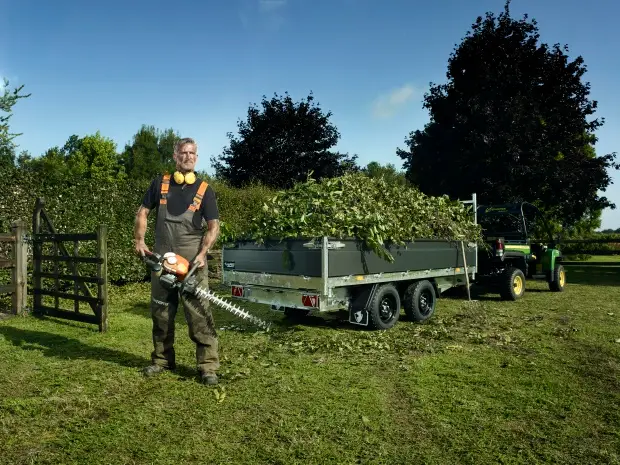
A trailer is not something you buy for just a short time. You want to be able to rely on strength, safety and ease of use. Today, tomorrow and ten years from now. That is exactly why sustainability at Hapert Trailers is not a separate part of the design, but a conscious choice in every detail.
Because choosing sustainably is not just about reducing emissions. It’s also about investing smartly. In quality that lasts longer. In materials that require less maintenance. And in a trailer that continues to perform year after year.
Using products for longer is an important part of a circular economy. The European Environment Agency explicitly mentions extending product life, repair and reuse as measures that can reduce the demand for new materials.
A trailer has to put up with a lot. Heavy loads, changing weather conditions, intensive use and long trips. Then you don’t want a solution that needs replacing after only a few years.
That is why Hapert Trailers builds trailers with a long service life as a starting point. Strong constructions, well thought-out material choices and finishing down to the details ensure that you choose long-term security.
The chassis is the foundation of every trailer. If that base is strong, you will notice it on every trip. That is why at Hapert Trailers you get 10-year chassis guarantee. This means that for the next ten years you are assured of a high-quality trailer that you can rely on.
For those hesitating between different brands, this is an important distinction. You’re not just buying a trailer. You’re choosing years of confidence, less worry and an investment that retains its value longer.

Sustainability often lies in choices that you may not see immediately, but that you will notice in the long run. For example, in lighting, use of materials and weight.
You can choose LED lighting instead of standard lighting. LED lighting lasts longer, is more energy efficient and requires less frequent replacement. That’s practical for you and better for the environment.
Fewer broken bulbs means less maintenance, less downtime and less waste. A small choice with a big effect in the long run.
At Hapert Trailers, we consciously choose materials that are strong, reliable and durable. Not because they simply look nice, but because they contribute to a trailer that lasts longer.
For our aluminium components, we use Hydro REDUXA, among other materials. According to Hydro, REDUXA has a carbon footprint of no more than 4.0 kg CO₂e per kilogram of aluminium, from bauxite mining through to casting.
Aluminum is strong, light and able to withstand intensive use. By choosing aluminum with low carbon emissions, the environmental impact is further reduced. At the same time, you benefit from a material that contributes to a sturdy, lightweight and durable construction.
A lighter trailer is also more economical to tow. You notice this on the road, especially with frequent use.
The composite floors we use are also a conscious choice. They are lighter than wood and resistant to moisture, dirt and wear. As a result, they remain in good condition for longer and require less maintenance.
By choosing a composite floor, you can save up to approximately 250 kg per trailer. A plywood floor weighs 10–15 kg/m², while a composite floor weighs only 4–6 kg/m². Depending on the floor surface area, this can result in a significant weight saving.
This provides several benefits. Less wear means less replacement. Less replacement means less waste. And less waste means less unnecessary resource consumption.
Durable materials sometimes require a higher investment when purchased. But those who look beyond the purchase price quickly see the benefit.
A sustainable trailer that lasts longer, requires less maintenance and is designed for long-term use is often the smartest choice over time. You avoid premature replacement, reduce maintenance costs and choose a product that is better able to withstand years of intensive use.
Less wear means less replacement. Less replacement means less waste. And less waste means less unnecessary use of raw materials.
That’s sustainable thinking in practice.
Hapert Trailers participates in the Remanufacturing Collective, in which Dutch manufacturing companies work together on reuse, repair and extending product life. This underlines our belief that sustainability does not stop at production. It is also about using materials, components and service life more intelligently.
By looking more consciously at reuse, recovery and value preservation, we are working on solutions that fit the future of transportation.
Still unsure which brand of trailer is best for you? Then look beyond just the first price. Look at longevity, warranty, choice of materials, maintenance and ease of use.
When comparing different trailers, many people first look at the purchase price. But for professional use, that price does not tell the whole story. The European Commission recommends that life-cycle costing should also include costs for use, maintenance, parts, replacement and any residual value. That is why at Hapert, we prefer to look at the costs over the full service life.
With Hapert Trailers, you choose a sustainable trailer that combines strength with durability. A trailer built with material choices focused on long service life and limited maintenance, easier towing thanks to its lower weight, and construction designed to last for many years.
That is no accident. It is the result of smart choices in design, materials and workmanship.
Strong in every detail.
Are you about to scale up with your business? Then the question is not whether you need a trailer, but which one from Hapert.
The longer you can use a trailer, the less quickly it needs to be replaced. This means fewer new raw materials and less energy are needed to produce a replacement trailer. Proper maintenance and the ability to repair or replace parts therefore contribute to a longer service life.
It can be, but the purchase price alone does not show what a trailer costs over its full service life. Maintenance, repairs, lifespan, replacement costs and residual value also play a role in the total cost of ownership. That is why it is wise to compare different trailers based on total cost of ownership, not just the purchase price.
The actual service life depends on use, load, maintenance and the conditions in which you use the trailer. Hapert designs its trailers for long-term professional use and offers a 10-year chassis warranty, in accordance with the applicable warranty conditions.
The chassis of a Hapert trailer is hot-dip galvanised to protect the steel against corrosion for the long term. Good corrosion protection helps extend the technical service life of the chassis, especially when a trailer is used intensively and in changing weather conditions.
Yes. Parts such as lighting, couplings, brake components, floor sections and other worn or damaged parts can be maintained or replaced, depending on the model. By repairing parts instead of replacing the complete trailer, the service life of the trailer can be extended.
For various models and components, Hapert uses galvanised steel, aluminium and composite, among other materials. We look not only at weight, but also at service life, maintenance, corrosion resistance and the possibility of reusing or recycling materials after use.
A lower unladen weight means the towing vehicle has to move less mass. This can contribute to lower energy or fuel consumption, although actual consumption also depends on factors such as speed, load, aerodynamics and the towing vehicle.
Aluminium can be recycled after use while retaining its material properties. In addition, recycling aluminium requires significantly less energy than producing primary aluminium. The total environmental impact does, however, depend on the origin and production method of the aluminium used.
Remanufacturing means that parts or products are repaired, renewed or reused so they remain usable for longer. The aim is to retain as much value as possible from existing materials and components, instead of replacing them too early with new raw materials.
Do not look only at the purchase price. Also consider the chassis construction, corrosion protection, quality of the materials used, repairability, availability of parts, warranty and expected service life. These characteristics largely determine how sustainable and economical a trailer is in the long term.