
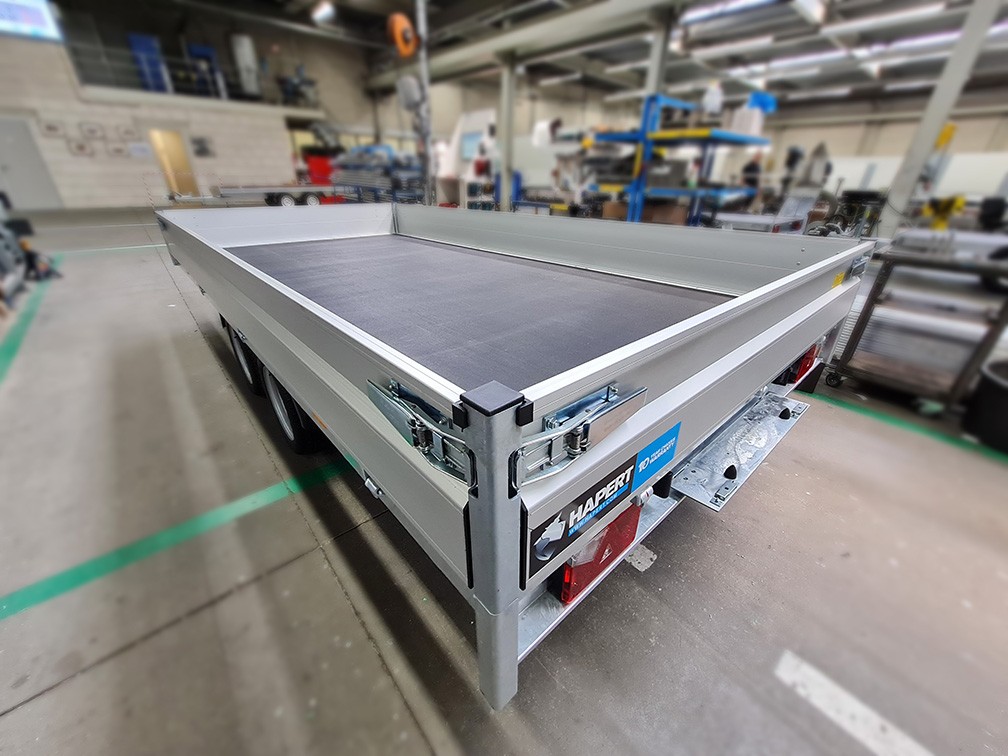
Most trailers have a load floor made of wood (plywood). HAPERT also offers a composite floor made of glass fibre and polypropylene. It weighs 4 to 6 kg per m², compared with 10 to 15 kg per m² for wood. It lasts longer and is recyclable. In this article you can read how the floor is built, how it has been tested and when it is worth it for you.
What is a composite floor?
Composite is a combination of materials that together are stronger and lighter than each one separately. The HAPERT floor is made of thermoplastic composite: long glass fibres in a matrix of polypropylene (PP).
The floor is built up layer by layer, like a lasagne. The core has a honeycomb structure with a top layer on both sides. The whole is fused into one strong panel. The top layer is built up like bulletproof vests, because the supplier originally comes from the anti-ballistic industry.

Composite and wood compared
Composite compared with wood (plywood)
- Weight: composite 4–6 kg/m², wood 10–15 kg/m²
- Weight saving per trailer: approx. 250 kg on a closed trailer, approx. 120 kg on a tipper with a steel floor
- Weather resistance: composite is not sensitive to moisture and temperature differences
- Repair: the top layer of composite is easy to repair
- Recycling: composite can be ground up and reused, while wood with glue and a plastic top layer is difficult to recycle
- Purchase price: composite costs a few per cent more
- Service life: composite lasts longer than wood
How was the floor tested?
HAPERT has tested the composite floor in the conditions in which trailers are used:
- impact (falling loads);
- tensile strength;
- shear load;
- wear;
- climate conditions.
Watch the video about the composite floor:
When does a composite floor pay off?
A composite floor is especially interesting if:
- your trailer is often outdoors or gets wet;
- every kilo counts, for example because you load close to the maximum weight;
- you want to use the trailer for a long time.
According to HAPERT, you are better off over the whole service life, thanks to the long life and lower fuel consumption.
Wood is a beautiful material, but very, very heavy.
HAPERT
Produced locally
The composite floor is produced to HAPERT's specification by Compoform in Ospel, the Netherlands. HAPERT showed the floor in March 2022 at the De Groene Sector trade fair in Hardenberg, the Netherlands. You can read the background in HAPERT introduces a recyclable composite floor.

Frequently asked questions
Can I have a composite floor repaired?
Yes, the top layer is easy to repair. If it is damaged, contact your HAPERT dealer.
Which models is the composite floor available on?
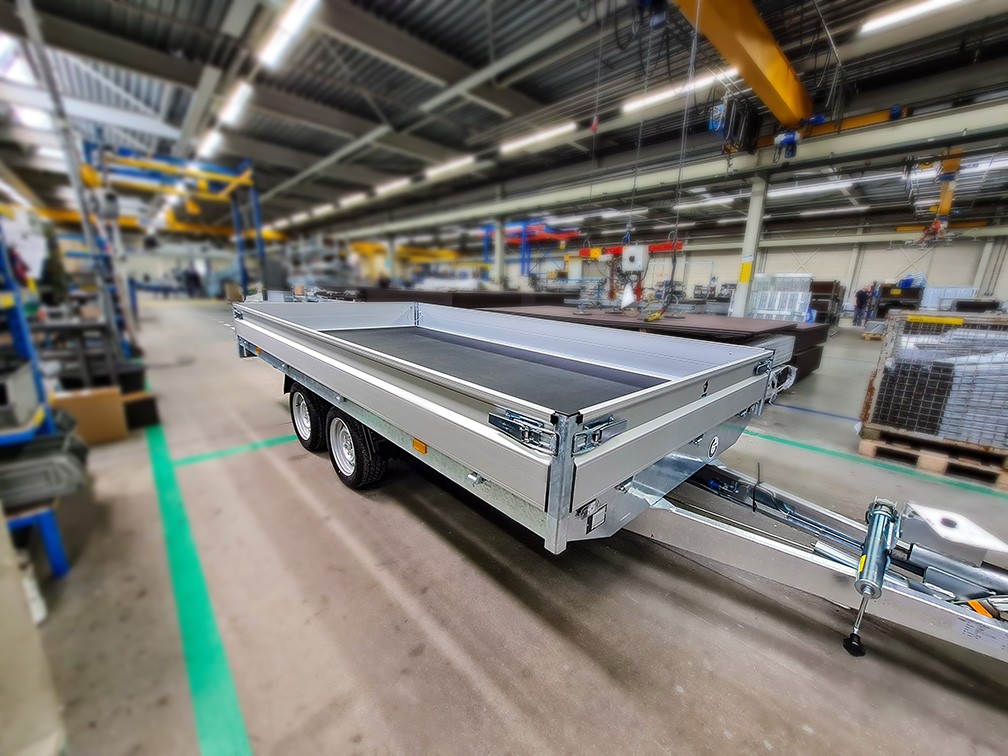
On hapert.com the composite floor is listed as an option on the Azure platform trailer, alongside a floor made of aluminium profiles. As standard the Azure has a plywood floor with an anti-slip layer. Ask your dealer whether the composite floor is also available for your model.
Written by the HAPERT editorial team. HAPERT (Wagenbouw Hapert B.V.) has been designing and building trailers up to 3,500 kg in Hapert (North Brabant, the Netherlands) since 1966 and sells through authorised dealers across Europe.
Sources
- Production: Compoform, Ospel