


Do you drive a van or car with a trailer to Belgium, Germany or another European country for work? Then since 1 July 2026, there is important legislation you need to take into account. The requirement to use a smart tachograph now also applies to a larger group of light commercial vehicles.
This is particularly relevant for entrepreneurs who regularly cross borders with a trailer. Think of construction companies, landscapers, mechanics, rental companies and other professionals who transport materials, machines or goods.
But when exactly is a tachograph required? And what does this mean when you drive with a Hapert trailer?
A tachograph records, among other things, the driver’s driving and rest times, speed and distance travelled. The latest generation, the Smart Tacho 2 (G2V2), also automatically records border crossings, among other data.
The tachograph enables enforcement authorities to check whether drivers comply with European rules on driving and rest times.
For professional goods transport with vehicles with a permitted maximum mass of more than 3,500 kg, the tachograph requirement has applied for some time.
Since 1 July 2026, this legislation has been expanded. For international goods transport with a vehicle or vehicle combination with a permitted maximum mass of more than 2,500 kg, a smart tachograph may now be required.
The trailer counts as part of this.
European legislation explicitly refers to the permitted maximum mass of the vehicle including any trailer or semi-trailer.
This makes the new legislation relevant for many users of a professional trailer.

This is probably the most important point to remember.
For the 2,500 kg or 3,500 kg limit, you do not only look at your towing vehicle. You look at the permitted maximum mass of the complete combination.
So:
permitted maximum mass of towing vehicle + permitted maximum mass of trailer = permitted maximum mass of combination
This concerns the permitted maximum mass as stated on the registration certificate. Not how much your vehicle and trailer actually weigh during that specific journey.
Suppose your van has a permitted maximum mass of 2,800 kg and you drive with a Hapert trailer with a permitted maximum mass of 2,000 kg.
The combination then has a permitted maximum mass of:
2,800 + 2,000 = 4,800 kg
For the tachograph rules, this means a combination of 4,800 kg is used, even if the trailer is only partially loaded during a journey.
For professionals who regularly cross borders, a lot has changed.
| Situation | Permitted maximum mass of combination | Tachograph requirement based on weight |
|---|---|---|
| Goods transport within the Netherlands | Up to and including 3,500 kg | In principle, not due to this weight limit |
| Goods transport within the Netherlands | More than 3,500 kg | In principle, yes |
| International goods transport | Up to and including 2,500 kg | In principle, no |
| International goods transport | More than 2,500 kg | Since 1 July 2026, in principle yes |
| Cabotage transport | More than 2,500 kg | Since 1 July 2026, in principle yes |
In cabotage, a company from one country carries out domestic transport in another country. The expansion of the European legislation also applies to this.
Please note: several exemptions exist. Checking only the weight of your combination is therefore not enough to determine definitively whether you need a tachograph.
A trailer itself does not automatically create a tachograph requirement. The requirement arises from the combination of the towing vehicle, the trailer, the type of transport and the way you use it professionally.
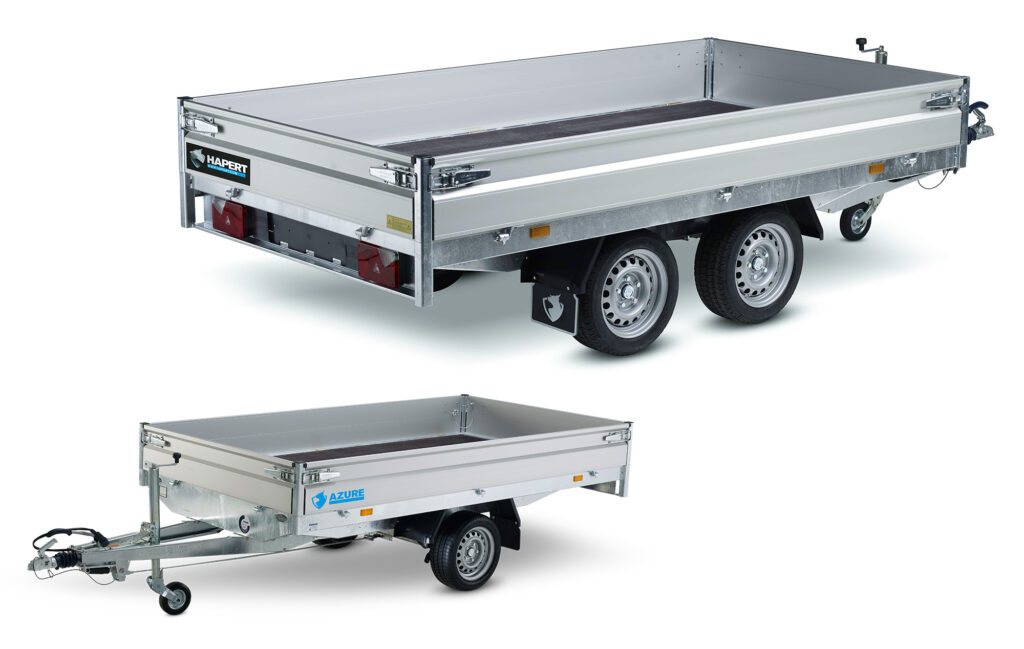
Hapert Trailers supplies trailers in various weight classes, from lighter single-axle trailers to professional tandem and tridem models with a permitted maximum mass of up to 3,500 kg. Examples include Azure platform and open box trailers, Cobalt tippers, Indigo transporters and Sapphire enclosed trailers.
As a result, many Hapert versions combined with a passenger car or van can exceed the 2,500 kg limit.
Not every tradesperson driving with a van and trailer automatically has to use a tachograph.
For example, there is an important exemption for vehicle combinations with a permitted maximum mass of up to 7.5 tonnes when transporting materials, equipment or machines that you need yourself to carry out your profession.
Conditions do apply. The transport must take place within a radius of 100 kilometres from the company’s place of establishment, driving must not be the driver’s main activity, and the transport must not be carried out for third parties. For the criterion that driving must not be the main activity, the ILT applies a maximum of 12 hours of driving per week.
This may be relevant, for example, when a tradesperson takes their own tools or machine to a job with a Hapert trailer.
For landscapers, there is also a specific national exemption within the Netherlands.
The ILT states that goods transport vehicles used by, among others, agricultural, horticultural and forestry companies for their own activities may be exempt within a radius of 100 kilometres from the company’s place of establishment. The ILT explicitly states that landscapers also fall under this exemption.
If you regularly drive as a landscaper with, for example, a Hapert Cobalt tipper, Azure platform trailer or Indigo machine transporter, this exemption may therefore be highly relevant.
Are you crossing the border or changing the way you use the combination? Then check again which rules apply.
For vehicle combinations between 2,500 and 3,500 kg, there is also an international exemption when goods are transported on behalf of the company or driver themselves, the transport is not carried out for third parties and driving is not the driver’s main activity.
Here too, the ILT applies a maximum of 12 hours of driving per week for the criterion that driving may not be your main activity.
The difference between, for example, taking your own machine to a job and transporting goods as a transport service can therefore be decisive for the tachograph requirement.
Before departure, always check at least:
The rules differ per situation. Especially when you drive professionally through several European countries, it is wise to check your specific combination and activities in advance.
The new tachograph rules do not change what you need from your trailer. You still want sufficient payload, stable road handling and a version that suits your daily work.
At Hapert, you can therefore choose from different weight classes and versions. From a manoeuvrable Azure for daily material transport to a Cobalt tipper for construction and landscaping, an Indigo for machines and vehicles, or an enclosed Sapphire for protected goods transport.
Which version suits you best depends not only on how much you want to transport. Also consider your towing vehicle, driving licence, activities and the countries in which you drive.
Not automatically. Since 1 July 2026, the tachograph requirement for international goods transport and cabotage applies in principle when the permitted maximum mass of the towing vehicle and trailer together exceeds 2,500 kg. Several exemptions exist.
Yes. When determining the weight limit, the permitted maximum mass of the trailer is added to that of the towing vehicle. This concerns the permitted maximum mass and not only the weight you are actually transporting at that moment.
Possibly. If you transport goods internationally and the permitted maximum mass of the combination is more than 2,500 kg, the tachograph requirement applies in principle since 1 July 2026. Always check whether an exemption applies to your activities.
That depends on the weight of your combination and the activities for which you use it. For transporting your own materials, tools or machines, exemptions exist under certain conditions. Being self-employed is not in itself an exemption.
Not always. In the Netherlands, there is a national exemption for, among others, landscapers transporting goods for their own business activities within a radius of 100 kilometres from the company’s place of establishment. For international journeys, you must separately check which European rules and exemptions apply.
For the weight limit, the permitted maximum mass of the vehicle and trailer is used. An empty trailer can therefore still count when determining whether your combination exceeds the legal limit.
The Human Environment and Transport Inspectorate (ILT) has a Tachograph Guidance Tool and publishes both national and international exemptions. If in doubt, always use the latest information from the ILT and the Dutch government.
This article is based on current information from the Dutch government, the Human Environment and Transport Inspectorate (ILT) and European legislation on driving and rest times and tachographs. The extension to international goods transport with combinations above 2,500 kg entered into force on 1 July 2026.
This page is intended to inform professionals in general terms about tachograph legislation. Laws, regulations and exemptions may differ depending on the situation. For your specific situation, always consult the latest information and the ILT Tachograph Guidance Tool.
No rights can be derived from this information. Wagenbouw Hapert B.V. is not liable for any inaccuracies or claims, including damage claims.
Updated on: 10 September 2026