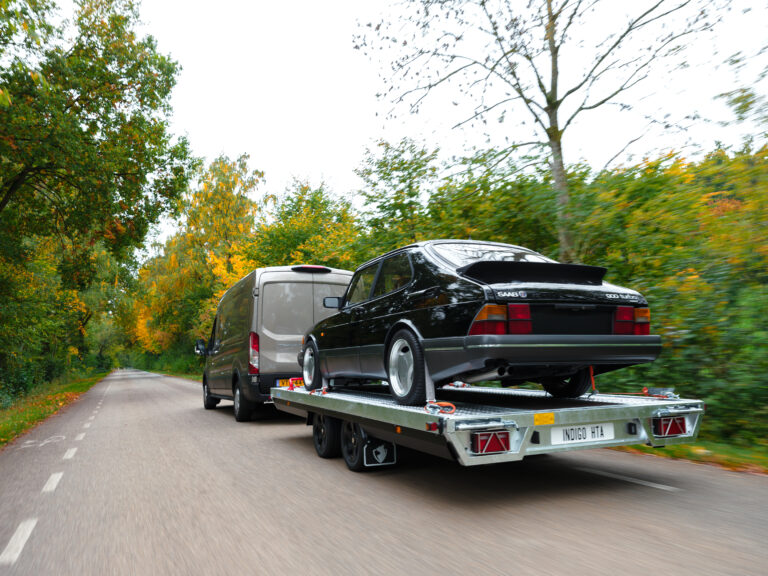

Trailer jockey wheel: which type do you need and why is it important?
Coupling, moving or parking a trailer? That is when you realise how important a good jockey wheel is. This relatively small component makes working with a trailer much easier. But not every jockey wheel is the same. Especially if you regularly transport heavy loads, a reinforced jockey wheel can be a smart choice.
At Hapert Trailers, every trailer is equipped with a jockey wheel as standard. From box trailers to tippers and machine transporters. For heavier applications, stronger versions are also available.
In this article, you will discover the different types of jockey wheels, when you need a heavier model and how to use your jockey wheel safely.
What is a trailer jockey wheel?
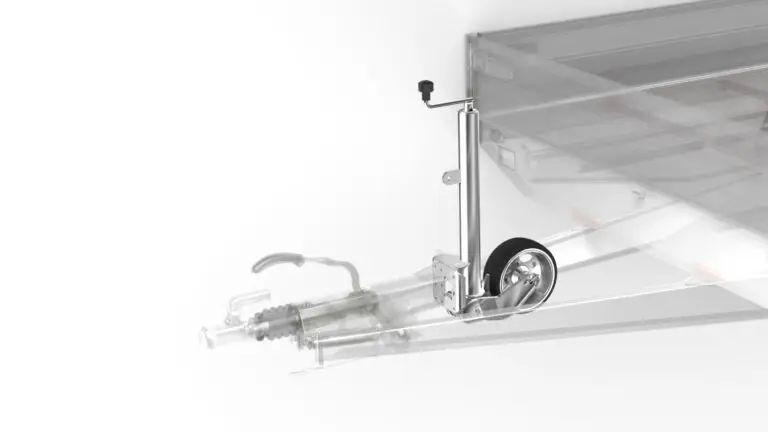
A jockey wheel is a height-adjustable support wheel at the front of a trailer, usually attached to the drawbar. It supports the front of the trailer when it is not coupled to a car.
By turning the handle, you can raise or lower the coupling head. This allows you to easily bring the trailer to the correct height to connect it to the towbar.
A jockey wheel has three important functions:
Easier coupling: you bring the coupling head to the correct height without having to lift the drawbar yourself.
Easier manoeuvring: you can move the uncoupled trailer over short distances, provided the weight and ground conditions allow this to be done safely.
Support when stationary: the jockey wheel supports the front of an uncoupled trailer.
A jockey wheel is also known as a trailer support wheel. Both terms are used for the same practical component.
Why is a jockey wheel so useful?
1. You do not have to lift as much weight
Without a jockey wheel, you have to lift the front of a trailer yourself to place it on the towbar. Especially with a loaded trailer, this can be physically demanding.
A jockey wheel takes over this vertical load during coupling, within its permitted load capacity. You only need to operate the handle to reach the correct height.
This reduces the physical effort required and makes coupling more comfortable.
2. You can manoeuvre more precisely
Is your trailer not quite in the correct position in front of the towbar? With a jockey wheel, you can move a suitable trailer a short distance more easily.
This is practical when you want to position the trailer in a garage, on your premises or in a workshop.
Please note: a jockey wheel does not automatically make a heavy, loaded trailer suitable for manual manoeuvring. The load, ground conditions and available manoeuvring space remain determining factors.
3. Your trailer is better supported
When you uncouple your trailer, the jockey wheel supports the drawbar. You can also use it to adjust the height of the front of the trailer.
Always park on stable ground and secure the trailer against rolling away. A jockey wheel is not a brake and does not replace wheel chocks or additional support legs.
4. It saves time in everyday use
Do you work as a landscaper, contractor or installer? Then you may couple and uncouple your trailer several times a day.
A properly functioning jockey wheel helps you do this more quickly and with less physical effort.
And especially when you use your trailer every day, you notice how much value small practical details can offer.
What types of trailer jockey wheels are available?
Not every jockey wheel is suitable for the same load or working conditions. Different versions are available, with differences in construction, operation and load capacity.
Standard jockey wheel
A standard jockey wheel is suitable for many common applications. It generally consists of an adjustable tube, a handle and a rubber or plastic wheel.
With versions equipped with a clamp holder, you can slide the jockey wheel upwards and secure it before driving.
Suitable for: normal use where the actual load and operating conditions remain within the specifications of the jockey wheel.
Automatic folding jockey wheel
With an automatic folding jockey wheel, the wheel automatically folds upwards when fully retracted. This means you do not have to manually slide the entire tube upwards every time.
This version offers additional ease of use, especially when you frequently couple and uncouple your trailer.
Suitable for: users who regularly work with their trailer and value convenience and quick operation.
Reinforced or heavy-duty jockey wheel
A reinforced jockey wheel is designed for applications where the load on the jockey wheel may be higher. Depending on the version, it has a more robust construction, a higher permitted load capacity and components suitable for heavier operating conditions.
This can be an important advantage for professional and intensive use.
Suitable for: heavy trailers, intensive use and situations where the actual load requires a jockey wheel with a higher load capacity.
A reinforced jockey wheel can also be a worthwhile investment when you regularly work with heavy materials, machinery or tools.
A good jockey wheel? We consider that essential.
At Hapert, every trailer comes with a jockey wheel as standard. For heavier applications, stronger versions are available. This means you are ready for the real work from day one.
Well equipped as standard. BRING IT ON.
When should you choose a heavy-duty jockey wheel?
A heavy-duty jockey wheel is not automatically necessary simply because your trailer has a high maximum permissible mass. The actual load on the jockey wheel and the way you use the trailer are the main factors that determine which version is suitable.
A reinforced jockey wheel is worth considering when:
You regularly couple and uncouple a heavily loaded trailer.
You use a heavy tipper, flatbed trailer or machine transporter.
You use your trailer intensively and professionally.
You frequently work on different or uneven surfaces.
You want a greater reserve in the permitted load capacity, within the specifications of the complete construction.
An important difference: the maximum permissible mass of your trailer is not the same as the load on the jockey wheel.
A trailer with a technically permissible maximum laden mass of 3,500 kg therefore does not automatically exert 3,500 kg of pressure on the jockey wheel. Most of the weight is supported by the axles and wheels.
The actual load at the front depends, among other things, on the load, the position of the axles and the weight distribution.
What does a load capacity of 250 or 500 kg mean?
The load capacity indicates the load that a jockey wheel may support according to the manufacturer’s specifications.
It is important to distinguish between:
- Static load capacity: the maximum permitted load when the jockey wheel is stationary.
- Dynamic load capacity: the permitted load when the jockey wheel is used to move the trailer. This value can be considerably lower.
A jockey wheel that can support 500 kg when stationary may therefore not automatically be used to manoeuvre a trailer with the same load.
Always check the specifications of the relevant jockey wheel and its mounting.
Please note: The load on the jockey wheel is not always equal to the nose weight at the coupling. The position of the jockey wheel and the trailer’s weight distribution also play a role. Always check the permitted load capacity of both the jockey wheel and its mounting.
Does a stronger jockey wheel also increase the payload?
No. A heavy-duty jockey wheel does not increase the legally or technically permitted payload of the trailer.
It also does not change the maximum permitted nose weight of the car, towbar or coupling.
The advantage lies in the suitability of the jockey wheel for the load during stationary use, coupling and, where permitted, manoeuvring.
Which type of jockey wheel suits your needs?
| Use | What should you consider? |
|---|---|
| Using a trailer occasionally | A suitable standard jockey wheel is often sufficient. |
| Frequent coupling and uncoupling | An automatic folding version offers additional convenience. |
| Transporting heavy building materials | Check whether a reinforced jockey wheel is advisable. |
| Transporting machinery or vehicles | Pay attention to the actual load on the jockey wheel and its load capacity. |
| Intensive professional use | Choose a version that suits the load, frequency of use and ground conditions. |
Which version is ultimately suitable depends on your specific trailer and how you use it.
Using a jockey wheel safely: 6 important points to consider
A jockey wheel is easy to operate, but incorrect use can cause damage or dangerous situations.
1. Fully raise the jockey wheel before driving
A jockey wheel must not touch the road while driving. A jockey wheel that hangs too low can become damaged or detached when, for example, driving over a speed bump.
Fully retract the wheel and secure it according to the instructions for the specific model.
2. Check the locking mechanism
Does your jockey wheel have a clamp holder? Check that it is securely fastened.
With an automatic folding model, check that the wheel is fully folded and correctly secured.
Also check that the jockey wheel does not touch any brake rods or other components.
3. Prevent the trailer from rolling away
Ensure a stable, preferably level surface. Use suitable wheel chocks and, where fitted and prescribed, the parking brake.
Never rely solely on the jockey wheel to keep a trailer in place.
4. Do not exceed the load capacity
A jockey wheel has a maximum permitted load. This also applies to its mounting on the drawbar.
Do not use the jockey wheel as a jack to lift a trailer for maintenance or repairs.
5. Take care when loading and unloading
When a trailer is uncoupled, the load on the jockey wheel can change significantly when you move heavy materials or load machinery.
Where necessary, keep the trailer coupled to the towing vehicle during loading and unloading and use the prescribed additional support. Always follow the trailer manufacturer’s instructions.
6. Check the jockey wheel regularly
Check that the wheel rotates freely, the handle operates smoothly and the mounting is in good condition.
Remove dirt and lubricate moving parts according to the maintenance instructions. Is the jockey wheel bent, damaged or worn? Have it inspected and replaced if necessary.
Is a jockey wheel legally required on a trailer in Europe?
European legislation does not impose a general requirement for every trailer to be equipped specifically with a jockey wheel.
However, certain trailers must have a height-adjustable support device under the European vehicle type-approval framework.
UN Regulation No. 55, which covers the approval of mechanical coupling components, specifies that centre-axle trailers must have a height-adjustable support device if the vertical load at the coupling exceeds 50 kg when the trailer is uniformly loaded to its technically permissible maximum mass. Certain specialised trailers are exempt from this requirement.
A jockey wheel can fulfil this function, but the regulation does not specifically require the support device to have a wheel. This requirement forms part of the technical approval framework applicable to trailers in the European Union, including Regulation (EU) 2018/858.
A jockey wheel is therefore not legally required on every trailer, but a suitable support device may be mandatory depending on the trailer’s design and coupling load.
For comfortable and safe coupling and uncoupling, a jockey wheel remains particularly practical, especially for heavier trailers.
In addition, you must always comply with the maximum permitted nose weight and the weight limits of the towing vehicle and trailer.
A jockey wheel with a higher load capacity does not change these legal limits.
National regulations and operating requirements may also apply in the country where the trailer is registered or used.
At Hapert, a jockey wheel is always standard
Why should you pay extra for something that makes everyday use of your trailer so much easier?
At Hapert Trailers, we believe that practical ease of use starts with good standard equipment.
That is why every Hapert trailer comes with a jockey wheel as standard. Whichever version you choose.
From a versatile Azure box trailer or flatbed trailer to a robust Cobalt tipper, an Indigo transporter or an enclosed Sapphire trailer.
For heavier trailers, stronger jockey wheels are also available. This allows you to adapt the equipment to the work you use your trailer for.
And that fits the way we build trailers at Hapert: robust, reliable and ready for the real work.
A trailer that suits your work
A good jockey wheel is important. But ultimately, it is about the complete trailer.
That is why, at Hapert, we not only focus on practical components, but also on construction, durability and everyday use.
With a fully welded and hot-dip galvanised chassis, robust construction and a 10-year chassis warranty, you choose a trailer that is built to last.
Configure your Hapert trailer and discover which version best suits your work.
Frequently asked questions about jockey wheels
Does every trailer have a jockey wheel?
No, not every trailer is equipped with a jockey wheel as standard. At Hapert Trailers, however, this is always the case: every Hapert trailer comes with a jockey wheel as standard.
What is the difference between a standard and a heavy-duty jockey wheel?
A heavy-duty or reinforced jockey wheel generally has a more robust construction and a higher permitted load capacity. It is suitable for applications involving higher loads. The exact load capacity varies by model.
How many kilograms can a jockey wheel support?
This varies depending on the version. For example, jockey wheels are available with static load capacities of 150, 250 or 500 kg. Also pay attention to the permitted load capacity when manoeuvring. This value may be lower.
Can I manoeuvre a loaded trailer using the jockey wheel?
Only when the actual load, ground conditions and operating instructions allow it. The dynamic load capacity of the jockey wheel must not be exceeded. Do not move a heavy trailer manually if it is unsafe to do so.
Must the jockey wheel be raised while driving?
Yes. Make sure the jockey wheel is fully raised and correctly secured before setting off. Check that it cannot drop down, touch the road surface or interfere with other components.
Is a jockey wheel mandatory on a 750 kg trailer in Europe?
No, there is no general European requirement for every 750 kg trailer to have a jockey wheel specifically. However, under UN Regulation No. 55, certain centre-axle trailers must have a height-adjustable support device if the vertical load at the coupling exceeds 50 kg under the specified loading conditions. A jockey wheel can serve as such a device, but it is not the only possible solution. National requirements may also apply.
When should I replace a jockey wheel?
When the jockey wheel is damaged, bent or excessively worn, no longer operates smoothly or can no longer be securely fastened. If in doubt, have the jockey wheel inspected by a Hapert dealer.
Can I fit a heavy-duty jockey wheel afterwards?
This is possible on some trailers, provided the mounting, available space, construction and permitted load are suitable. Have a dealer assess which version is permitted for your trailer.
Where can I buy a Hapert trailer with a jockey wheel?
All Hapert trailers are equipped with a jockey wheel as standard. You can configure your preferred model using the online configurator or ask an official Hapert dealer for advice.